
Pistol Duel
KAYAC Inc.Action
4.3322.00 Reviews
- Version
- 045
- Installs
- 10.00M
- Age Rating
- Teen
Screenshots


Our Review of Pistol Duel
 Analysis by Appyee
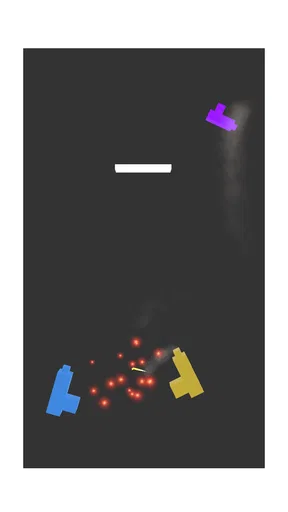
Pistol Duel caught my attention because it turns a familiar action-game idea into a compact contest built around recoil. Instead of treating a pistol as a simple point-and-shoot tool, the game makes the kick of the weapon part of the movement and decision-making. That gives each encounter a slightly unusual rhythm: firing is not only about damaging an enemy, but also about managing where the next burst leaves you.
After spending time with it, I see this as a game for people who enjoy quick decisions and simple controls with a small tactical twist. It is free to play, belongs to the action category, and comes from KAYAC Inc. Its central appeal is easy to understand within seconds, but getting comfortable with recoil-powered movement takes more attention than the short description suggests.
How the recoil changes the pace of play
The first thing I noticed was the sense of speed. Pistol Duel does not need a complicated control scheme to feel active. The weapon’s recoil creates motion, so every shot can affect both the enemy and my own position. That makes the action feel more immediate than a conventional pistol game where I simply stand still, aim, and repeat.
That speed is best understood as short bursts of concentration rather than a long, exhausting sprint. I can make a quick attempt when I have only a few minutes, yet the design still leaves room for mistakes. A careless shot can put me in a worse position, while a well-timed shot can turn the same recoil into an advantage. The important skill is not firing as fast as possible; it is learning when the kick helps and when it makes the situation harder.
Players coming from standard shooting games may need a brief adjustment period. In those games, recoil is often something to control or reduce. Here, it is part of the toolset. I had to stop thinking of it purely as a penalty and start treating each shot as a possible movement input. That change gives the game its identity, even though the basic premise remains easy to grasp.
The short-session structure also affects how I judge its speed. It is not trying to offer the broad exploration of a large action adventure, nor the layered progression of a full tactical shooter. Its strength is the immediate encounter. I can open it, understand the objective quickly, and get into the action without preparing a loadout or learning a large map.
That convenience makes it a good fit for a commute, a short break, or the few minutes before another task. In an everyday situation, I might play while waiting for an appointment: one attempt gives me a focused challenge, and I can put the phone away without feeling that I abandoned a long campaign. Someone looking for a deep evening game will probably find the format more limited.
What happens when the action gets busy
The most demanding moments are not necessarily the ones with the most visual activity. The pressure comes from having to judge recoil, target position, and timing together. When several decisions arrive close to one another, a small error can compound quickly. I may fire to hit an enemy, shift position unintentionally, and then have to recover from the new angle.
This is where the game feels more thoughtful than its simple presentation might imply. I found it useful to pause mentally before a shot instead of tapping immediately. A split-second check of where the recoil will send me can prevent a chain of rushed corrections. That habit is one of the more valuable lessons the game teaches, and it applies especially well when an encounter becomes crowded or visually confusing.
Another practical tip is to separate offensive and positional goals in my head. Sometimes the best shot is the one that creates a safer angle, even if it is not the most direct attack. At other times, trying to reposition through repeated firing only makes the situation less predictable. Recognizing that difference helped me avoid treating every problem as a damage race.
Heavy-use moments also reveal the trade-off behind the game’s compact design. The same recoil mechanic that makes the action distinctive can become tiring if I play continuously without a break. Repeating similar high-attention encounters may feel less varied than a larger action game with exploration, puzzles, or several weapon types. I would recommend short sessions for most players, especially if the appeal is the precision of each encounter rather than a long progression journey.
For younger players, the content rating is Teen, so families should use that as the starting point when deciding whether it suits them. The action is clearly the focus, and the game should be approached as an action title rather than as a relaxed puzzle experience. I would not recommend handing it to a child simply because the controls appear straightforward.
Stability, recovery, and the cost of a mistake
My impression of reliability is tied closely to how quickly I can understand and resume an attempt. Pistol Duel benefits from a focused concept: there are not many systems competing for attention before the action begins. That makes it feel approachable when I return after a day away. I do not have to reconstruct a complex build or remember a large story thread before playing again.
Recovery inside an encounter is a different matter. Because recoil changes position, recovering from a bad shot is not always as simple as correcting the aim. I may need to wait for a better opening or use the next shot carefully to regain control. This gives failure a useful lesson, but it can also frustrate players who prefer forgiving action where a mistake is quickly erased.
I found the best recovery method was to slow down after an error rather than immediately compensate with more shots. Rapidly repeating the same input can make the original problem worse. Watching the new position, identifying the nearest safe opportunity, and then acting deliberately is more effective. That is a specific habit worth carrying into the game, because it turns failed attempts into information instead of mere irritation.
On the stability side, I would keep expectations realistic. The game’s appeal depends on responsive interaction, so any touch delay or interruption would matter more here than in a turn-based title. I would avoid judging it during a moment when my phone is overloaded with other tasks, and I would keep the device in a comfortable grip. Those are ordinary precautions, but they matter when a single shot changes both attack and movement.
The game has reached a substantial audience, with over ten million installs and an average rating of 4.3 from around twenty-one thousand ratings. Those figures suggest that its basic idea connects with many players, while the rating also leaves room for individual preferences and occasional friction. I would read that combination as a sign of broad accessibility, not as a guarantee that every player will enjoy the recoil-focused controls.
Phone requirements and practical expectations
Pistol Duel supports devices running Android 5.1 or later, which gives it a wide compatibility range on paper. That is helpful for people using an older Android phone who do not want to upgrade simply to try a small action game. Still, an operating-system requirement does not tell me exactly how every device will behave under extended use.
For an older phone, I would begin with short sessions and pay attention to touch response, heat, and whether switching away from the game causes the current attempt to reset. Those checks are more useful than assuming that a compatible operating system means identical performance across every handset. A newer phone may provide a smoother experience, but the game’s compact premise is still more suitable for quick play than for demanding marathon sessions.
Resource demands are also worth considering from a practical angle. Since the game centers on pistol duels and recoil-based action rather than a large open world, I would expect its main challenge for a device to be responsiveness during play, not the management of a huge environment. I would not promise identical battery use or loading behavior on every phone, but players who care about efficiency can test it during a normal short session before committing to longer play.
Storage planning is straightforward in one sense: the game is free to download, so the initial decision does not require a purchase. Free access makes it easy to experiment, but I still recommend checking the current device space before installing any game. A free title can be convenient without being the right choice for someone who wants a completely uninterrupted, distraction-free experience.
One advantage for casual users is that the game does not demand that I organize a long play schedule. I can use it as a quick reflex exercise, a way to reset my attention between tasks, or a small competitive challenge against my own previous performance. If I need a game that runs in the background of a busy routine, however, this is not ideal: the recoil mechanic rewards attention, and divided focus makes mistakes more likely.
Where it stands beside familiar action alternatives
Compared with a traditional shooting game, Pistol Duel feels more focused and less concerned with realistic weapon handling. The pistol is not just a source of damage; its recoil is the central interaction. That makes the experience easier to explain but also narrower. Players who want many weapons, broad maps, or a long campaign should choose a larger action game instead.
Compared with a physics-based arcade title, it has a more direct combat purpose. The movement created by firing is not merely a visual joke; it affects how I approach an enemy and how I recover from a poor decision. That gives the game a sharper action identity than a simple novelty app, although it may feel less relaxing than an arcade game built around low-pressure experimentation.
It also differs from turn-based dueling games because timing and immediate control matter more than planning several moves ahead. I cannot rely only on careful menu choices. The best results come from combining a quick read of the situation with restraint. Conversely, players who dislike pressure or who prefer to analyze every move without a timer-like feeling may find the format uncomfortable.
The game is a particularly good match for someone who likes discovering one strong mechanic and testing its limits. It is less suitable for a player who judges an action game mainly by its story, character customization, online community, or large collection of modes. I would also steer away from it if the recoil concept sounds annoying rather than interesting, because that mechanic is not a minor side feature that can simply be ignored.
Small habits that make the duels easier to read
My first useful habit was to avoid holding the phone too tightly. A relaxed grip made it easier to make precise touches and notice how each shot changed my position. This sounds minor, but a game built around recoil punishes tense, hurried input. I also found it helpful to keep my finger ready without covering too much of the action area.
Second, I started treating the opening moment as an observation phase. Rather than firing instantly, I looked at the starting arrangement and considered the direction in which a shot would push me. That tiny delay often produced a cleaner first move. It is especially useful for new players who initially assume that speed alone is the goal.
Third, I learned to review the cause of a failed attempt. Was the shot poorly timed, was the recoil direction misunderstood, or did I react too quickly afterward? Asking that question gives each restart a purpose. Without it, the game can become a loop of repeating the same input and hoping for a different result.
Finally, I would play with a stable connection to the device’s normal controls and avoid unnecessary multitasking. I would not claim that this changes the game’s underlying performance, but it reduces avoidable interruptions. In a title where a single action can alter the whole position, a notification, awkward grip, or accidental touch is more disruptive than it would be in a slower game.
Who should install it, and who should pass?
I recommend Pistol Duel to action fans who want a free, compact game with a mechanic they can understand quickly but practice over time. It works well for short breaks, older Android devices that meet the minimum system requirement, and players who enjoy turning an apparent drawback into a movement tool. The developer, KAYAC Inc., has chosen a clear hook rather than burying the experience under a long list of systems.
I would skip it if my priority were a story-driven adventure, a realistic shooting simulation, or a broad multiplayer-style experience. I would also pass if I wanted relaxed tapping with minimal consequences. Recoil is the reason to play, but it is also the main source of frustration. The game asks me to adapt to its physical logic instead of letting me control the action in the most familiar way.
The current version is 045, and the game was released on October 5, 2025. Those details help place the review in context, but my recommendation rests more on the actual design choice: every shot has a positional consequence. The free price lowers the barrier to trying it, while the Teen rating is an important consideration for families.
After a busy day, I would use it as a focused five-minute diversion rather than as my main action game. It gives me a reason to replay an encounter because improvement comes from understanding recoil, not simply from waiting for a stronger weapon. That kind of compact mastery can be satisfying, though players who need constant novelty may reach its limits sooner.
My final verdict is positive with a clear condition: enjoy the recoil idea, and you will probably find a brisk little action game with more decision-making than its simple presentation promises. If that idea sounds like an obstacle, the rest of the experience may not be enough to change your mind. Pistol Duel is at its best when I treat every shot as both an attack and a movement choice. For that reason, I would recommend trying it free, using short sessions at first, and deciding based on whether its unusual control rhythm feels clever or simply inconvenient.
Verdict
Strengths of Pistol Duel
- Quick matches make it easy to play during short breaks.
- Simple controls are accessible for casual players.
- Duel mechanics create tense, competitive moments.
- Offline play may be convenient when no connection is available.
- Lightweight gameplay should run well on many devices.
Limitations of Pistol Duel
- Repetitive rounds can reduce long-term variety.
- Progression may feel limited for experienced players.
- Ads can interrupt the flow between matches.
- The game may offer little strategic depth over time.
- Multiplayer quality can depend on matchmaking or connection stability.
Other Releases by KAYAC Inc.
View All
Ball Run 2048: merge number
Casual4.1

Number Master: Run and merge
Action4.4

Type Spin: alphabet run game
Racing4.5

Draw Action: Freestyle Fight
Action4.3
Similar Picks in This Category
View All
Temple Run 2: Endless Escape
Imangi Studios4.1

PUBG MOBILE
Level Infinite4.3

Free Fire: 9th Anniversary
GARENA INTERNATIONAL I4.4

Talking Tom: Hero Dash Run
Outfit7 Limited4.3

slither.io
Lowtech Studios3.9

Sniper 3D:Gun Shooting Games
Wildlife Studios4.6
Frequently Asked Questions
What is Pistol Duel and how does the game work?
Pistol Duel is a fast-paced shooting game focused on one-on-one gunfights and quick reactions. Players face opponents in short duels, aim carefully, and fire at the right moment to win. The gameplay is easy to understand, but later challenges usually demand better timing, accuracy, and awareness. It is designed for brief sessions and straightforward entertainment rather than a complex story-driven experience.
Is Pistol Duel free to download and play?
Pistol Duel can generally be downloaded for free, allowing players to try its main gameplay without an upfront purchase. However, the app may include advertisements, optional in-game purchases, or other monetization features depending on the version and platform. Before downloading, it is worth checking the store listing for current pricing details, available purchases, and whether removing ads requires an additional payment.
Does Pistol Duel require an internet connection?
The connection requirements may depend on the specific version of Pistol Duel and the features you want to use. Basic gameplay may be available offline on some devices, while advertisements, online competitions, cloud features, or updates can require internet access. If you plan to play while traveling or without mobile data, test the game after installation to confirm which modes remain accessible offline.
Is Pistol Duel suitable for children?
Parents should review the age rating before allowing children to download Pistol Duel. Although the game uses simple arcade-style mechanics, its central theme involves firearms and shooting opponents, which may not be appropriate for every child. The app may also contain advertising or optional purchases. Checking device parental controls, store permissions, and the game’s content description is recommended before installation.
What devices are compatible with Pistol Duel, and does it need much storage?
Pistol Duel is intended for mobile devices running a supported version of Android or iOS, but exact compatibility can vary after updates. It is usually a relatively lightweight game compared with large 3D titles, although the download size may increase because of additional assets, cached advertisements, or future content. Check the official store page for the latest requirements and keep some free storage available for updates.
Play our best games!


